Director Danny Boyle is back to his thriller roots with this art heist flick starring James McAvoy, Vincent Cassel, and Rosario Dawson.

I didn’t know Boyle was even working on another movie after ’127 Hours’ and the London Olympics. As best I can tell, this one comes out in the UK in March but doesn’t have a US release date at the moment.

The plot seems a little convoluted, with McAvoy playing a thief hunted by Cassel’s art auctioneer and Dawson is some kind of hypnotherapist trying to unlock a secret? The cinematography looks strange and unnerving and it’s Danny “fucking” Boyle, so how can this not be good? [via firstshowing]

Pixar shared a brief clip from its photorealistic short, The Blue Umbrella. The clip isn’t all that interesting — it’s just two umbrellas in the rain — but it does hint at an interesting new direction that Pixar could take with its animated features. [via PCB]

Amazon launched its new AutoRip service today. On the surface it sounds pointless: buy a CD and get the MP3s for free. But, dig deeper and it could be handy if you’ve bought a ton of physical music albums from Amazon over the years.

The service works with the Amazon MP3 store to give you free MP3 copies of CDs you’ve purchased from Amazon dating all the way back to 1998. The AutoRip feature is turned on automatically, so if you purchase a CD from Amazon — past or present — it will automatically download the MP3 version to your Amazon Cloud Player.

Who buys CDs though?

Here is every national anthem in the world, combined.

The piece begins with the national anthem of Uruguay, Himno Nacional de Uruguay, which is commonly regarded as the longest in the world, and usually runs between four and seven minutes in performance. Seven seconds later, the anthem of Guatemala (Himno Nacional de Guatemala, colloquially known as Guatemala Feliz!) enters, followed soon after by the distinctive drums and trumpets of the Algerian anthem Qassaman. Then, in quick succession, there is Mexico, Turkey, Brazil and Vietnam. Most of the rest of the South American anthems enter at this point, along with a couple of European anthems, and Libya.

There is a ‘bulge’ around the two-minute mark, when a handful of different anthems all start at around the same point (including most European and Asian anthems), and another around the two-and-a-half-minute point (mostly Sub-Saharan Africa). From here on, it gets pretty difficult to tease out details of any one anthem from the rest, and, well… it just gets messier after that. See if you can spot yours!

Political minutiae: the audio combines the national anthems of all 193 member states of the United Nations, plus Palestine and the Holy See/Vatican City (the two United Nations non-member observer states), and Taiwan (technically an applicant for UN membership). Apart from China and Taiwan, Israel, Cyprus, Armenia, North and South Korea, and the already-mentioned UN observer states, it does not include any anthems of states with limited recognition, or any anthems of the world’s wonderful micronations. It also does not include any historical anthems.

You know you want to listen to this just to hear what all of the world’s national anthems sound like squished together. It’s quite rousing and a bit easier to listen to than every Billy Joel greatest hit played at once.

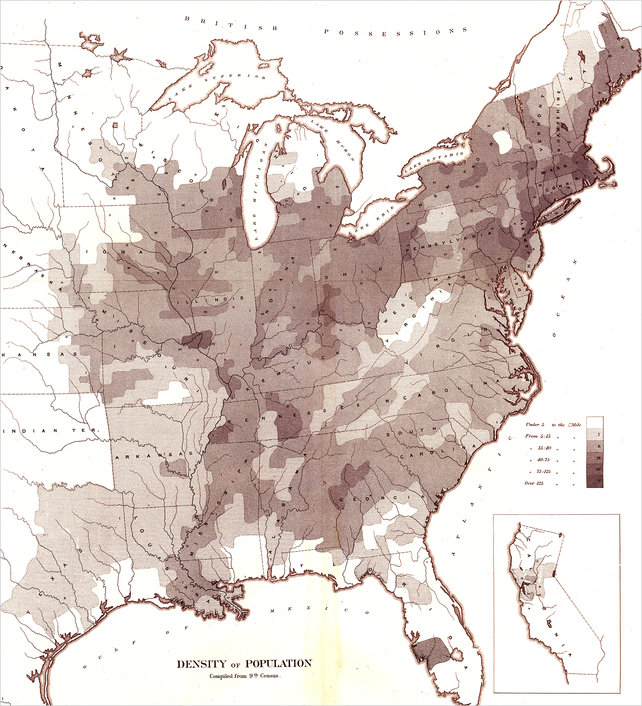
1671605-inline-inline-1-1872-population-densityFrancis Amasa Walker was a highly decorated Union soldier and became the superintendent of the Census in 1870 at the age of 29. His experiments with data mapping led to the modern practice of infographics and data visualizations.

This position gave him the chance to think of the census not just as a tool of enumeration and political apportionment (its original purpose), but as an instrument of research and development. Think of Walker as an early advocate of data mining for the nation. To properly exploit the census, however, he had to make sense of the data, and this led him to experiment with maps and infographics.

In 1872, he issued the first of several groundbreaking attempts to map the American population through the census. But instead of using preexisting units-such as county or state divisions-he took the more labor-intensive step of mapping the population according to its actual contours. By doing this, he moved closer to seeing the population as it existed in space, irrespective of political boundaries.

Civil War history’s affect on modern internet culture = Total Sly Oyster linkbait.

2013 Oscar Nominations

by James Furbush on January 10, 2013 · 0 comments

The Best Pictures from 2013 are: Beasts of the Southern Wild, Silver Linings Playbook, Zero Dark Thirty, Lincoln, Les Misérables, Life of Pi, Amour, Django Unchained, and Argo.

I really don’t know how this is going to shake out. It feels like Beasts, Amour, and Lincoln just became the favorites based on all the other nominees.

The Tyranny of Man

by James Furbush on January 10, 2013 · 0 comments

Steve Cutts created this darkly hilarious look at man’s relationship with the natural world. Spoiler alert: it doesn’t end well for nature.

Cutts really makes you feel depressed in this tour de force piece of animation and cultural critique. [via shortoftheweek]

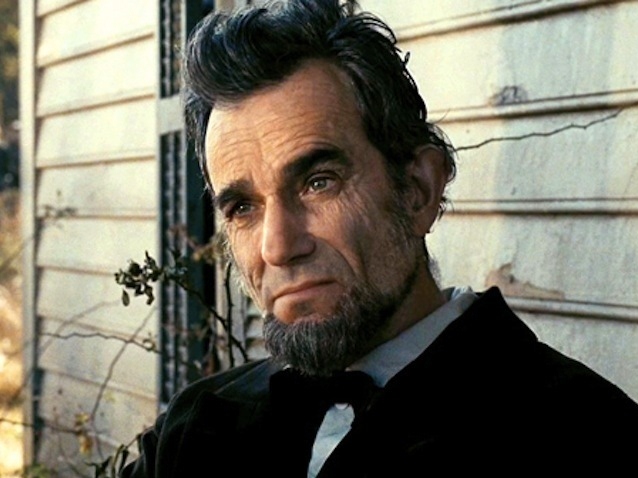
lincoln“It was a real pleasure just to sit and talk with you. I listened very carefully to what you had to say about this compelling history, and I’ve since read the script and found it in all the detail in which it describes these monumental events and in the compassionate portraits of all the principal characters, both powerful and moving. I can’t account for how at any given moment I feel the need to explore life as opposed to another, but I do know that I can only do this work if I feel almost as if there is no choice; that a subject coincides inexplicably with a very personal need and a very specific moment in time. In this case, as fascinated as I was by Abe, it was the fascination of a grateful spectator who longed to see a story told, rather than that of a participant. That’s how I feel now in spite of myself, and though I can’t be sure that this won’t change, I couldn’t dream of encouraging you to keep it open on a mere possibility. I do hope this makes sense Steven, I’m glad you’re making the film, I wish you the strength for it, and I send both my very best wishes and my sincere gratitude to you for having considered me.” — Daniel Day-Lewis, informing Spielberg that he initially had no interest in playing Lincoln. Good thing he changed his mind.

This conversation between author George Saunders and his long-time editor, Andy Ward, is a nice follow-up to that wonderful profile of Saunders from last week. My favorite part is this exchange on editing/re-writing:

1301_SBR_TenthOfDecember_COVERWard: A lot of people say to me, “God, it must be so fun to work with George Saunders. Do you even have to edit him at all?” And they say it like they assume you shun all editing, or don’t allow editing, which is always really funny to me, because you are a person who craves feedback, who wants to be pushed and challenged and sent off in new directions. This all sounds self-serving, I realize, so I should add: Of course, at this stage, you don’t need an editor. But you want an editor. Why?

Saunders: No, I definitely need and enjoy having an editor, and for the exact reasons you state. There’s a really nice moment in the life of a piece of writing where the writer starts to get a feeling of it outgrowing him—or he starts to see it having a life of its own that doesn’t have anything to do with his ego or his desire to “be a good writer.” It’s almost like an animal starts to appear in the stone and then it starts to move, and you, the writer, are rooting for it so hard—but may not be able to see everything clearly after working on that stone for so long.

If a writer understands his work as something that originates with him but then, with any luck, gets away from him, then what he needs is someone who can grasp the potential of the piece and lead him to that higher ground. (I’m aware I’m mixing metaphors here. OK: One ascends to the higher ground, and on that higher ground is a sculpture of a bear, a bear that is “coming alive” and “outgrowing” him. And the editor is encouraging him to “grasp the potential of” the bear. Aiyee.)

One of the things that you are really great at is simultaneously acknowledging the parts that are working and showing me to the places where the piece could be working better—it’s a genuine kind of encouragement that is literally “en-couraging”—it makes me feel, “OK, I can do this, Andy likes Part A and Part B, so I can go back to Part C and find a bit more in it.” There’s also a way that you have of being precise but also allusive, that works well for me—it’s something about the open-hearted way you frame your queries. Instead of feeling daunted or discouraged, I feel excited to give whatever it is a try. This takes a lot of editorial wisdom and confidence—to know just how to get the writer to take that extra chance.

All great writing is re-writing. It’s one of the few truisms of this world.

So, not the United States, basically. That’s according to a study by the Economist Intelligence Unit, which looked at 80 countries, scoring them across 11 variables to determine “which country will provide the best opportunities for a healthy, safe and prosperous life in the years ahead.”

The United States and Germany ranked 15th on the list of best countries to be born in.

Yes, it’s yet another international ranking on individual well-being where the Nordic countries come out on top, alongside Ireland, Australia, New Zealand and Canada. The top 15 also include Austria and Switzerland, which seem to meet similar criteria. The three best places to be born are, in order: Switzerland, Australia and Norway.

Here’s a surprise: the top-ranked countries also include Asia’s two super-rich city-states, Hong Kong and Singapore, as well as Taiwan. I’ll admit to being surprised by the data’s suggestion that a newborn today is better off being Taiwanese than American or German, particularly because Taiwan’s aging population and declining birthrate could lead the economy to decline. But Taiwan does enjoy good political freedoms and improving health and living standards.

There is some interesting variation among the top-ranked countries. New Zealand ranks seventh overall even though its GDP per capita is low compared to many worse-ranking European countries. Singapore, though ranked sixth, is not a liberal democracy by any stretch, and life satisfaction in the hyper-competitive city seems relatively low. But it sure is rich.

Anyway, take it all with a grain of salt.