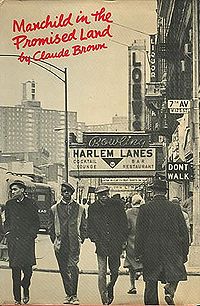
History’s lens is often reduced to competing dialectics; the ease and comfort of simple black versus white explanations. It is the worst form of rewriting history. A prime example of this is the Civil Rights movement. For those people whose only experience of this time period is through a fifth-grade history book, one would suspect that all African-Americans aligned themselves with either the philosophies of Martin Luther King Jr. or Malcolm X.
This is a disservice to nuance, however. Life is much more complex than that, evidenced by Claude Brown’s wondrous account of his life during the Civil Rights movement in Manchild in the Promised Land.
Published in 1965, Manchild in the Promised Land is an inner city coming-of-age tale first and foremost. Claude Brown’s fictionalized retelling of his own life is a complex story of survival and hope; one that history often buries for convenience sake. Raised on the streets of poverty-stricken Harlem, Brown’s childhood was one of crime, drugs, hustlers and violence all recounted in angry slice of life details.
Brown’s protagonist Sonny spends time in and out of various reform schools from the age of nine. When not at school he spends his days selling drugs and hanging out with his Italian friend Minetti. He grows up, gets his GED and moves down south to live with his grandparents for a brief time escaping from his city prison. But the book doesn’t reach majestic heights until he returns to Harlem as a young man. It is there that we see why Sonny had to escape his home, why he had to get out of Harlem.
His younger brother was living the same criminal life he used to; close friends and loved ones had overdosed from heroin. All around him chaos is swirling as the Civil Rights Movement barrels forward. Though he experienced both the peaceful non-violent resistance favored down south and the black power movement favored in the northern inner cities, it becomes evident that Sonny was too busy surviving his own life to be concerned with Civil Rights.
Sonny, and by extension Claude Brown as well, grew up to understand that there was no solution to black equality. While he may have been angry at his environment, he was intelligent enough to know that blacks cannot function in America without help from their white counterparts. He saw people for what they were and understood what he needed to do to get away from Harlem and save himself without having to rely on others such as the SCLC, the Islamic faith, or the black power movement.
Coming-of-age tales generally make the most compelling memoirs, there is nothing like rooting for a person to become the best version of themselves, to learn and grow and be born out of their harrowing environment. But what makes this one particularly interesting and an essential one is that it takes what you think you know about a specific era in American history and offers an alternative. Sonny considers the pull of the black power movement and understands the wisdom behind Martin Luther King Jr. and the Southern Christian Leadership Conference. This story of human survival and empowerment suggests, like The Life and Times of Frederick Douglass (the quintessential work of African-American empowerment), that education is the great equalizer.
Manchild in the Promised Land is a transcendent work of unequaled importance. It is one of the few books about the Civil Rights movement to capture the sadness and trauma of everyday life in city ghettos. People will be reading this thoroughly entertaining story for years to come – if for nothing else than bucking conventional wisdom and offering an inspiring character to root for. We want Sonny to succeed and escape his horrible life and when he does, well, elation is the word that springs to mind.